
Interview with Thierry Genay
What first drew you to the idea of the cabinet of curiosities as a framework for this body of work? Was there a specific moment, object, or question that set the series in motion?
The cabinet of curiosities can be considered part of the still life genre. For me, the starting point was an ostrich egg that a friend lent me. It is one of the most classic objects found in cabinets of curiosities. So I wanted to combine it with other objects in the same spirit. At the same time, a company that manufactures this type of object and appreciates my work invited me to come to their photo studio with my personal equipment and choose the objects I wanted to photograph. So I began composing this series in that studio. Then I looked at what I had at home in terms of curiosities, and friends lent me some, and I bought some too.
"This series is already influencing my work in general. I hope this series has broadened my approach to combining objects. To suggest other stories."
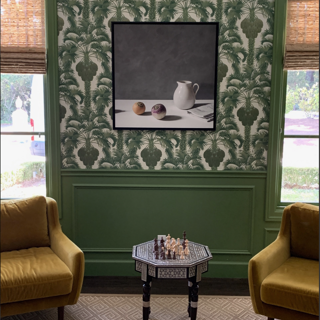
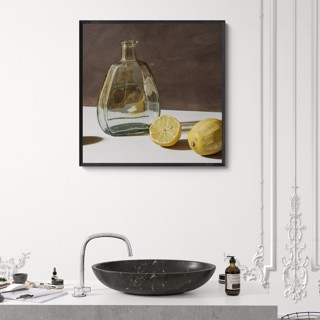
Photo courtesy Liz Kahn Design
The objects feel carefully chosen yet emotionally charged. How do you
decide when an object earns its place within the composition? What does it need to “do” for you?
I have two ways of choosing an object. Either I choose an object for its particular character and then associate it with other objects, or I choose a combination of several objects from the outset. I like objects that have a strong meaning (and at the same time are very mundane), such as a book that symbolizes knowledge, associating it, for example, with a more surprising object like a small frame with an eye. The eye can evoke curiosity, which goes perfectly with knowledge. But this is just one interpretation among many, and viewers are free to find their own according to their sensibilities. I try to leave a degree of mystery precisely to allow freedom of interpretation.
Historically, cabinets of curiosities were about wonder, knowledge, and
control. Which of those ideas feels most alive for you in this series, and why?
Historically, starting in the 20th century, the cabinet of curiosities, particularly under the influence of surrealism, became, in my opinion, less historical and more personal. Collectors used it to express their personality, sensitivity, and tastes. That's the direction I chose to take. The first photograph you chose speaks of the world of wine. The flavors of wine, how to taste it, and nature. The second refers to the arts and represents some of them. The third is more symbolic.
How much of this work is intuitive versus deliberate? At what point does
thinking give way to seeing, or vice versa?
The creation of a series is deliberate, even if the starting point may be due to a chance encounter. Then the choice of objects is rather intuitive, especially their combination. Combining objects with each other, but also combining objects and materials. I think it's a constant back-and-forth between reflection and intuition. It's also an encounter with the objects themselves, objects that tell a story or have a history. I like objects that are marked by time and use. There is a human element behind these objects. Sometimes, certain objects in my compositions evokes very specific memories in viewers at an exhibition.