
Interview with Sarah Bird
When you’re standing before a 300-foot giant, how do you decide which part of its "face" to capture so that we, as viewers, feel it looking back at any of us?
Recognition among humans and trees is more complex than human to human. The question implies that trees are "just like us,” centering human experience. I do not believe they are like us at all, and what I am trying to do in my portraits is to create a potential for relationality that exists all the time between humans and trees, but that perhaps has gotten lost in contemporary culture. I do not see a face or believe they “look” back, but I do feel a sense of kinship and mutual being-ness that I am trying to create in the artworks. The part I decide to photograph is an area of the tree that I have a physical relationship with, being to being, body to body.
"The part I decide to photograph is an area of the tree that I have a physical relationship with, being to being, body to body."
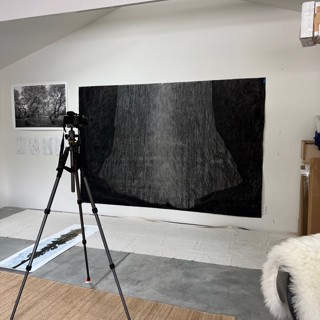
Photo courtesy Liz Kahn Design
How does the act of photographing something so much older and larger than yourself help you find your own right-size in the world?
When I started photographing the redwood trees, I was awed by their presence and curious to know if I could bring that into the artworks. The sense of awe and wonder at being in relation to the natural world de-centers my human importance. It gives me perspective. It turns out that social scientist at Berkeley and other places have been studying this phenomenon, and in addition to periods in nature being restorative to humans , it also makes us kinder and more compassionate, And recent research shows that looking at artworks can have the same effect.
(See Awe: The New Science of Everyday Wonder and How It Can Transform Your Life the book by Dacher Keltner)
How does the time it takes to create these massive prints change your own internal rhythm?
Time is an interesting concept. We tend to think of time running in a straight line, faster and faster, and there is never enough of it, but this is just one kind of time, and is a creation of the industrial age, where humans and nonhumans were conscripted into the system as commodities. Tree time has something to teach me about the fictions of modern time, and attuning myself to the sensibilities of long, cyclical, and reiterative tree time by making large scale and labor-intensive artworks is a recalibration and resistance to the fictions of the present. These fictions continue to cause so much damage to the planet and its people.