
Selections from IFPDA Fair
One of the best bits of collecting advice I ever received came from my mother. She and my father spent years building a collection of postwar modern work, and she carried that love forward with patience and enthusiasm. The advice she gave me was practical and turned out to be insightful: if you’re drawn to an artist and the canvas (or sculpture) is out of reach, find the work on paper. She was not describing a workaround. She was describing a philosophy, and a strategy.
The Motherwell in her collection came to her when Motherwell was still a bet worth making, not yet the consensus masterwork he became. A work on paper made that acquisition possible. Motherwell called paper the most sympathetic of all painting surfaces, arguing that it possesses naturally what canvas requires a struggle to achieve, and in this work, you feel exactly what he meant. The lines land with a quietness that would be harder to achieve anywhere else. My mother understood that intuitively. The work on her wall has been making that argument for decades.
Robert Motherwell, Naples Yellow Open, etching and aquatint in color #6/ 62 (along with 1960's rotary phone).
What paper makes possible
Motherwell described drawing as exploring the "realm of possibilities," a medium where the "act and the end result are one. " That compression is the key to understanding what works on paper offer. There is less infrastructure between the artist's impulse and the finished surface, less opportunity for revision, and less room to hide. A drawing captures a decision as it was made. A monotype preserves the pressure of a hand. A watercolor holds the moment before the pigment dried.
Scale is also part of the argument. Works on paper ask you to move closer. They reward proximity in a way that large-format painting rarely does, and that shift changes the relationship between the object and the person looking at it. You are not standing at a polite distance, taking in a composition. You are leaning in.
What to look for
Condition matters more with paper than with almost any other medium. Ask whether a work has been stored flat or rolled, and whether it has been exposed to light or humidity. Foxing, the small brown spots that appear as paper ages, can in some cases be addressed through conservation, but it affects value and should be disclosed. Fading in works that use fugitive pigments, certain watercolors, felt-tip media, some pastels, may be irreversible. Reputable galleries will have this information and should share it without prompting.
Edition size matters in multiples. A print from an edition of eight behaves differently in a collection, and on the market, than one from an edition of two hundred. Understand not only the number but also whether the plate or matrix has been destroyed, which limits future production. Ask to see the colophon.
Beyond condition and edition, look for works that hold something back. The best works on paper are not exhausted by a single viewing. They have interiority, a mark that does not resolve, a surface that rewards returning to. That quality is harder to quantify than foxing or edition size, but it is ultimately what determines whether a work earns its place on the wall.

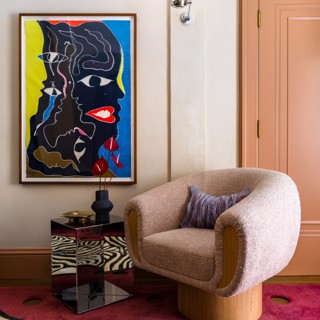

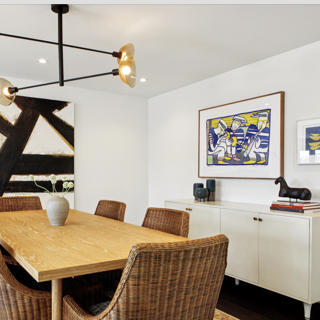
Left to right recent installs: Leslie Shows, Lonnie Hollie (for Ballon Studios Designer Showcase, Ian Davenport, America Martin
The market case
Works on paper have historically entered collections at lower price points than the same artist's paintings or sculptures, which creates opportunity, particularly for collectors building relationships with artists whose careers are still ascending. A drawing acquired early in an artist's development often becomes one of the most significant works in a collection, not only in market terms but in terms of what it reveals about the artist's thinking over time.
This is exactly what my mother understood. The opportunity she recognized then exists right now, with a different set of artists. At the same time, the most significant works on paper by established artists trade at the level of paintings and deserve to. Price point alone is not the argument for paper. The argument is that the medium, considered on its own terms, offers access to something that other forms do not.
A note on framing and care
UV-protective glazing is not optional. Light is the primary threat to works on paper, and standard glass offers almost no protection from the wavelengths that cause the most damage. Museum-quality framing with conservation-grade matting and UV acrylic or glass is a reasonable baseline for any acquisition you care about. Rotate works on paper off the wall periodically when you can. Even protected works benefit from rest.
Motherwell described the feeling of satisfaction in drawing as a kind of "zing!" moment, pure joy and release. That immediacy is precisely what makes works on paper worth collecting seriously, and worth caring for with the same attention you bring to everything else on your walls.
Mom at 85. We gifted Robert Indiana works on paper to commemorate her birthday and love of collecting art. (She still has the phone).